
Real Money Casino Table Games in Australia
 Available in AU
Content
A guide to live-dealer and RNG formats, Australian rules, table menus, odds, and the basics of card, roulette, and poker games.
What Online Table Games Actually Change
The main difference is where the game’s visible action comes from. In a live-dealer format, a real dealer uses real casino equipment, and a video feed carries that activity to players. In a software-led version, a Random Number Generator (RNG) determines the result: for example, which cards are dealt or where a roulette ball lands.
That distinction can be easy to miss when both formats appear on a screen. The interface may look like a table in either case, but the image does not tell you how the result was produced. In a live game, you are watching a physical setup through a stream. In a digital game, the table and its activity are presented by software, while the RNG supplies the outcome.
A table on screen, two different sources
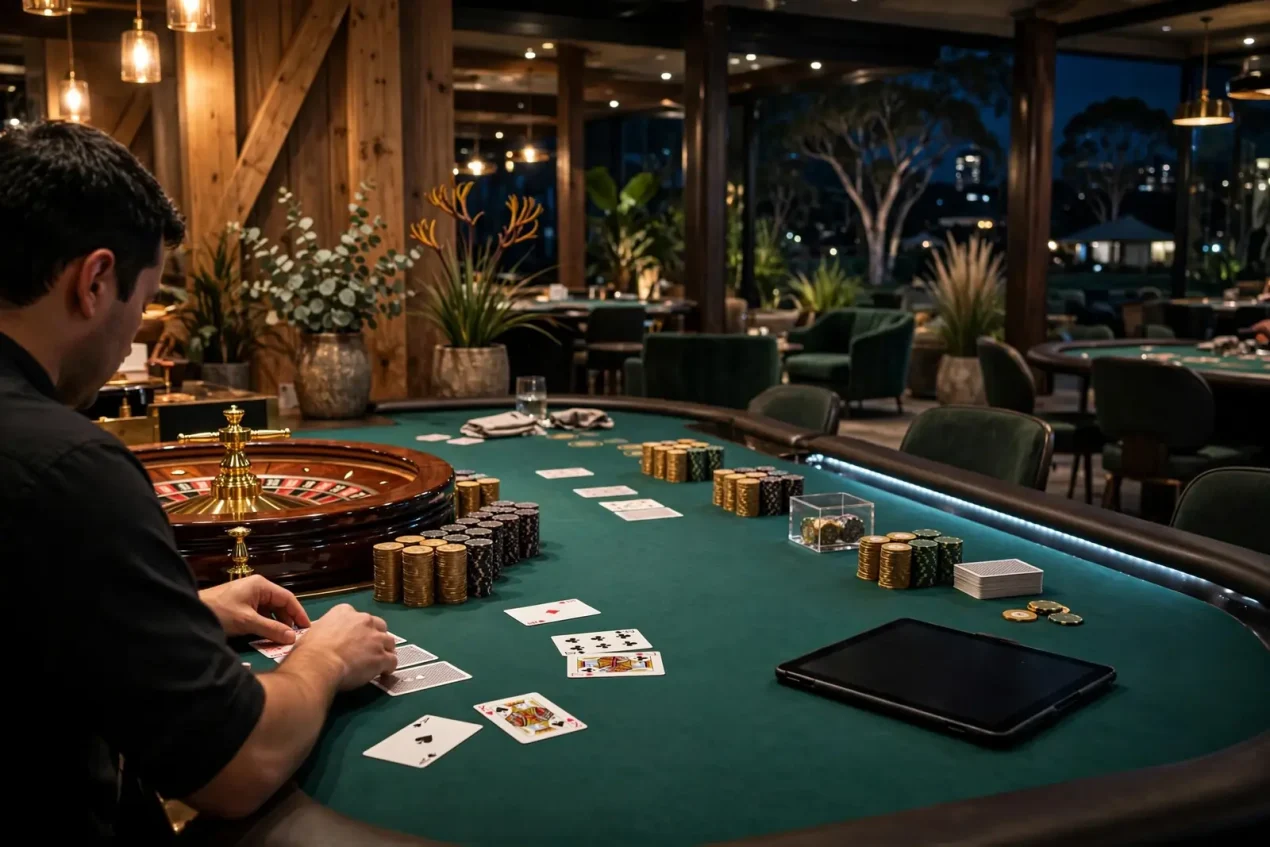
With a live dealer, the stream is the connection between the physical game and the player’s screen. You see a real dealer and real equipment rather than a software animation representing them. The game’s action takes place at that equipment, while the video lets players follow it remotely.
7-Reel Slots in Australia: RTP, Rules and Free Play
That does not mean you are sitting at the same table as the dealer. You are watching a live video feed, not looking across a physical table. The distinction matters because the screen is showing an event taking place elsewhere, rather than simply displaying a digitally generated scene.
A software-led table works differently. There is no live dealer whose physical actions produce the cards or roulette result shown on screen. Instead, an RNG determines the relevant outcome, and the software displays it. The graphics may be designed to resemble a familiar table, but the appearance is not the mechanism.
Put plainly: one format shows a real game in progress; the other uses software to determine and display the result. Same screen, different source.
What the RNG does—and what it does not mean
For digital table games, the RNG is the part that determines outcomes such as the cards dealt or the roulette ball’s landing place. The interface then presents that result in a way that fits the game. A card may appear on a virtual layout, or a roulette result may be shown on a digital wheel.
Three-Reel Slots in Australia: RTP, Free Play and Rules
It is worth keeping the description narrow. Knowing that an RNG determines an outcome tells you how the software-led format works; it does not, by itself, tell you anything about a particular game’s quality, fairness, or suitability. Nor does the moving animation explain how the result was generated. The important distinction is between the mechanism and its on-screen presentation.
The same caution applies to live video. Seeing a dealer and equipment tells you that the format uses a real physical setup and a live stream. The video is the way you observe the game remotely. It is not a reason to assume that every detail about the platform or its operation is visible in the picture.
What changes for the viewer
The clearest difference is what you are watching. In a live-dealer format, you follow a person operating real equipment through streamed video. In a software-led format, you follow a digital presentation of an outcome selected by an RNG. One feels like watching a physical table from a distance; the other is a software interface built around a generated result.
Neither description says which format is better. That depends on what you mean by better, and the distinction here is about operation, not game choice. A live feed does not turn remote play into an in-person visit, while a digital table does not become a live game just because its graphics look realistic.
This also helps make sense of labels used in menus. “Live dealer” points to the streamed, physical setup. A digital table without that live-dealer format relies on software to produce the outcome. If the label is unclear, look for whether the game is described as a live stream with a real dealer or as a software-based version. The visual style alone can be misleading.
The Australian context
These formats describe how an online table game operates, not whether it may legally be offered to people in Australia. A live stream and an RNG are different technical arrangements; neither changes the legal status of a real-money online casino game. Keep those questions separate. A format label is not permission.
Whether a game uses a live stream or an RNG is a technical arrangement; it does not change the legal status of a real-money online casino game in Australia.
So when you encounter a table shown on a screen, the useful first check is simple: is the result being produced through a real dealer and physical equipment shown on a live feed, or is software using an RNG to determine and display it? That tells you what kind of online presentation you are looking at—nothing more.
The Australian Rules You Need to Know First
For real-money online casino games, the key point in Australia is the law governing the operator, not the table’s format or the way a player pays. The Interactive Gambling Act 2001 (IGA) sets the national framework. Under Section 5, an operator based in Australia cannot offer residents real-money interactive casino games. In practical terms, a locally based company cannot make an online casino available to Australian customers as a real-money service.
That restriction applies to casino-style play online, rather than only to one particular table or payment option. Whether a service presents itself as a Bitcoin casino, takes another form of payment, or uses familiar casino language does not by itself change the legal status of the service. A payment method is not a separate permission to provide gambling.
Pokies in Tasmania: Venue Hours, Access and Checks
The IGA is aimed at the provision of prohibited interactive gambling services to people in Australia. The legal frame therefore matters when a service is described as an online casino, including when it offers games commonly associated with a casino table. A label such as “table games” does not put the service outside the law.
ACMA’s role
The Australian Communications and Media Authority (ACMA) is responsible for enforcing the relevant rules. Its role includes taking action against unlicensed online gambling services and blocking access to services that are not permitted to operate for Australians. A site appearing in a search result, or loading on a device, is not proof that it is authorised under Australian law. Access and legality are different questions.
This is worth keeping in mind when you see claims that an online casino is “open” to Australian players. That wording describes what a site says about access; it does not establish that the service is lawful. Nor does a foreign licence make an operator locally licensed. The Australian framework does not turn on a site’s marketing language.
Legal Restriction
Under the Interactive Gambling Act 2001, an operator based in Australia cannot offer residents real-money interactive casino games.
The same distinction applies to Bitcoin. “Bitcoin table games” describes a payment-related feature, not a special legal category that overrides the IGA. Using cryptocurrency does not convert a prohibited casino service into a permitted one. The payment rail may differ; the underlying activity remains the relevant issue.
So, if you are trying to understand the rules before acting, focus first on what the service provides and to whom. Real-money online casino play offered to people in Australia falls within the IGA’s restrictions. ACMA’s enforcement work, including blocking unlicensed services, is part of how those restrictions are applied. A site’s availability should not be mistaken for approval.
That is the market-wide context; it is not a recommendation to use any online casino. Claims about the “best” Bitcoin tables or the best table-game odds do not answer the legal question, and a payment option does not settle it either. Before treating a service as legitimate, distinguish its own claims from the rules that apply in Australia. Simple, but easily missed.
Why “Best Odds” Needs More Than a Label
When choosing a real-money table-games site in Australia for 2026, check the available operator and payment details before deciding where to play. These short verdicts highlight only the information provided for each listing.
1. Bizzo Casino
License: Curacao Gaming Control Board (TechSolutions Group N.V.)
Bizzo Casino lists the Curacao Gaming Control Board as its licensing authority, with TechSolutions Group N.V. named as the operator.
2. Playfina Casino
License: Curacao eGaming (Hollycorn N.V., since 2017) · Min. deposit: A$20-30 (depends on the offer)
Playfina Casino lists a Curacao eGaming licence held by Hollycorn N.V. since 2017. Its stated minimum deposit is A$20–30, depending on the offer.
3. GoldenCrown
License: Curacao Gaming Control Board OGL/2023/176/0095 (Hollycorn N.V.)
GoldenCrown lists Curacao Gaming Control Board licence OGL/2023/176/0095, held by Hollycorn N.V.
4. Golden Pokies
License: Curacao
Golden Pokies lists Curacao as its licensing jurisdiction.
5. Ricky Casino
Payout speed: crypto under 1 hour, PayID 1-3 business days · Min. deposit: A$20 (A$30 to qualify for the bonus)
Ricky Casino lists crypto payouts in under an hour and PayID payouts in 1–3 business days. The minimum deposit is A$20, or A$30 to qualify for the bonus.
6. Wild Tokyo
License: Curacao · Payout speed: crypto 30-60 minutes, fiat 1-5 days · Min. deposit: A$10
Wild Tokyo lists a Curacao licence and a A$10 minimum deposit. Its stated payout times are 30–60 minutes for crypto and 1–5 days for fiat.
7. MrPacho
Payout speed: crypto 30-120 minutes, fiat 24-72 hours · Min. deposit: A$30
MrPacho lists a A$30 minimum deposit, with stated payout times of 30–120 minutes for crypto and 24–72 hours for fiat.
8. 7Bit Casino
License: Curacao, operated by Dama N.V.
7Bit Casino lists Curacao as its licensing jurisdiction and Dama N.V. as its operator.
9. SkyCrown
License: Tobique Gaming Commission · Payout speed: crypto ~10-15 minutes, fiat 1-5 days · Min. deposit: A$30
SkyCrown lists a Tobique Gaming Commission licence and a A$30 minimum deposit. Its stated payout times are around 10–15 minutes for crypto and 1–5 days for fiat.
10. Vegaz Casino
License: Curacao OGL/2024/1335/0780 · Min. deposit: EUR 20
Vegaz Casino lists Curacao licence OGL/2024/1335/0780 and a minimum deposit of EUR 20.
A claim that a table game has the “best odds” sounds precise, but it is not a useful comparison on its own. Odds can refer to the chance of a particular outcome, the return attached to a bet, or the house edge. Those are related ideas, but they are not interchangeable. A game may offer a frequent small win and still be a poor choice by another measure.
That is why I would not trust a ranking that simply names the best casino table games without explaining how it reached that verdict. To compare games fairly, you need a stated measure and the assumptions behind it. The relevant rules, available bets and decisions during play can all affect the comparison. Leave those out and a neat-looking chart can hide more than it explains.
RTP is another term that can muddy the water. It describes a theoretical return over a very large number of plays, not a promise about what one person will get back in a short session. The RTP figures discussed in casino material concern pokies. They do not establish a return for blackjack, roulette, poker or other table games, so they cannot support a table-game odds ranking.
A house-edge chart has the same problem if it offers a single figure without showing what it applies to. You would want to know which version of the game and which bet the figure describes, as well as any assumptions about how the game is played. Without that context, comparing entries may be like comparing two prices when one includes something the other leaves out. The chart may look tidy. That does not make the comparison sound.
Mines Casino Game in Australia: Search Guide
This also explains why a confident “best odds” label can be less helpful than it appears. It might refer to one particular bet rather than the game as a whole. It might describe a theoretical long-run result, not the likelihood of winning a hand or round. And it may leave out choices that change the conditions being compared. Those details matter more than the headline.
If you are weighing up table games, start by asking what “best” means to you. Are you looking for a higher chance of a particular outcome, a particular payout, or a lower stated house edge? Then check whether the comparison is about the same kind of bet and the same assumptions. If those basics are absent, the ranking is not giving you enough to make a sound comparison.
I would treat “worst odds” claims with the same care. A game-wide label can flatten important differences between bets, versions and ways of playing. A chart can still be useful when its terms are clear and its comparisons are like for like; without that, the label does the work of an argument without showing the reasoning.
There is no honest shortcut from pokies RTP to table-game odds. Keep the measures separate, look for the conditions behind any comparison, and be wary of a ranking that offers a verdict but no method. Less impressive. More useful.
Do
- Check the stated measure and assumptions behind odds
- Compare the same type of bet and assumptions
- Distinguish between RTP and table-game odds
Don’t
- Trust rankings that name “best games” without a method
- Use pokies RTP to judge table-game odds
- Rely on a single house-edge figure without context
The Basic Decisions Behind a Table Game
A table round is easier to follow when you separate two things: what you are backing and what result the game compares. That simple distinction helps when you are learning the rhythm of a game, whether the decision is about a hand, a named side or the outcome of a dice roll. I find it more useful than trying to memorise a menu of options before understanding what each bet is about.
In blackjack, the central comparison is between your hand and the dealer’s. The aim is to finish with a value closer to 21 than the dealer’s hand. So the basic question behind a wager is whether your hand will meet that aim. The dealer is not just dealing cards in the background; their hand is the point of comparison. Keep that in view and the objective is plain.
That does not mean every decision in a round can be reduced to a prediction about one card. The target is the final hand value relative to the dealer’s, not simply whether your total moves upward. When you are learning how to play, follow the comparison from your hand to the dealer’s rather than treating the number 21 as the only thing that matters. A hand can be close to the target and still need to be judged against the other hand. Clear enough; no shortcut.
Crash Casino Games in Australia: How They Work
Baccarat-style betting is organised differently. Instead of backing your own hand against a dealer, you can place a bet on the Player hand, the Banker hand or a tie. The choice is therefore about which of those outcomes you are backing for the round. Before placing anything, make sure the labels are clear to you: “Player” and “Banker” identify the two hands, while “tie” is a separate possible result. The names tell you where the wager is directed; they do not, by themselves, explain how a round will finish.
Dice play centres on another kind of decision. Players roll a pair of dice and bet on the outcome. Here, you are backing a result associated with the roll rather than comparing a card hand with a dealer’s. That makes the question more direct: what outcome does the wager refer to, and does the roll match it? The exact bet matters, so take a moment to connect its wording to the result it covers before committing.
Across these examples, the useful habit is the same: identify the event your wager depends on. In blackjack, it is your hand’s value compared with the dealer’s. In baccarat-style betting, it is which hand you have backed, or whether the result is a tie. In dice play, it is whether the roll produces the outcome you selected. Those are different decision structures, even though each round involves placing a bet and waiting for a result.
If you are learning the basics, explain the bet to yourself in one sentence before a round starts: “I’m backing this hand,” or “I’m backing this dice outcome.” If that sentence is unclear, pause and read the table’s wording again. Understanding what a wager refers to is more useful than choosing quickly.
Understand Your Wager
- Identify the event the wager depends on
- Explain the bet to yourself in one sentence
- Verify the table’s wording if the bet is unclear
Looking for a Casino Nearby? Check the Location, Not the Search Phrase
A request for a casino with table games close by sounds specific, but it does not identify a verified venue. A search result can match the words you entered without showing that a casino is nearby, open, or offering the games you have in mind. Treat the wording as a starting point, not confirmation.
I’d first check what “nearby” means in the result. A page may refer to a different suburb, city or country, particularly when the search phrase is broad or the location has not been made clear. A result for a casino in another country is not a local option simply because it mentions table games. Nor does a venue’s name or map marker tell you what it currently offers.
Then check whether the result is about a physical venue or an online service. They are not interchangeable. A page describing online casino tables does not establish that there is a casino you can visit nearby; a local venue listing does not establish that it offers online play. Keep those two meanings separate before you rely on any details.
The word “new” needs the same care. It might describe a recently published page, a newly added game, or a venue someone calls new. By itself, it does not establish that a new casino has opened in your area, or that a particular table game is available there. Look for a clear location and a direct, current description of the venue rather than drawing a conclusion from the label.
Bonus Buy Slots in Australia: How the Feature Works
If you are checking a physical venue, compare its stated address with the place you actually mean. A result can be geographically relevant without being the closest, and “closest” depends on where you are starting from and what you count as a practical journey. Don’t assume the first result settles either point. If the page gives no usable location, it has not answered the nearby part of your question.
Likewise, the phrase “with table games” is not proof of a particular offering. A general casino description may not name the tables available, and a page about one game does not confirm the rest. Make sure the information applies to the venue and location you are checking, rather than to casino games in general.
Australian readers should also be alert to results that point to online casino services. A result appearing in a local search does not make that service a local venue or change the rules that apply in Australia. Don’t read visibility as endorsement, availability or legal approval.
I’d use one simple test: can you identify the actual place, its location, and what the page says is offered there? If not, the result hasn’t verified a nearby casino with table games. Search wording can be neat. Reality is less obliging.
What Counts as a Casino Table Game?
A casino table game is a game organised around a shared table format: players make choices or place bets within a defined round, and the outcome is settled according to the game’s rules. The “table” describes the style of play, not necessarily a piece of furniture in front of you. In a digital version, the same broad category can appear on a screen.
Table Game Components
I find it useful to separate three ideas: the game family (the activity), the format (live dealer or software-led), and the interface (on-screen layout or physical table).
That distinction matters because the category is wider than any single game. Card-based play, a wheel-based game and dice play can all fit under the table-game label, even though the player’s role and the way a round unfolds differ. The label tells you the general format; it does not, by itself, explain the rules, the pace or what decisions you will make.
At a physical casino, a table has a dealer, equipment and a layout for play. Online, there are two broad ways to represent that experience. In a live-dealer game, a real dealer operates real casino equipment, while a live video stream carries the action to players. You see the table being run rather than simply receiving a computer-generated animation.
A software-led version works differently. A random number generator determines the dealt cards or, in roulette, where the ball lands. The display may still look like a table, but the result is generated by software rather than shown through a live feed of real equipment. The distinction is about how the outcome is produced and presented, not whether one format automatically counts as a table game and the other does not.
I find it useful to separate three ideas: the game family, the format, and the interface. The game family is the kind of activity taking place. The format is whether you are watching a live dealer or using a software-led version. The interface is the on-screen layout or physical table through which you take part. Those labels can sit together, but they answer different questions.
Casino in Tasmania: Venue and Online Play Guide
So, when someone asks what table games are in a casino, the short answer is a group of casino games built around rounds, bets and a defined outcome, rather than one particular game or one kind of screen. A live stream does not turn the category into a different game family, and a digital table does not need a physical dealer in the room. Same broad label, different machinery.
That is the useful frame before looking at individual games: identify whether the table is live or software-led, then consider the particular game. A menu or screen can use familiar table imagery, but appearance alone does not tell you how the result is generated. Check the format description. Small detail, real difference.
How to Read a Table-Game Menu
A table-game menu is easier to make sense of when you read it in layers. The first layer is usually the format: a streamed live table or a digital game. The next is the game family, such as card games, roulette or dice games. Those labels tell you how the menu is organised; they do not, by themselves, tell you what is available to play in Australia.
“Live” has a specific meaning here. A live-dealer game uses a real dealer and casino equipment, with video streamed to players. That separates it from a digital table game, but the category name alone doesn’t tell you which rules, table limits or other conditions apply. Check the details attached to an entry rather than assuming that every item in the same category works alike.
A "Live" label indicates the use of a real dealer and equipment via video stream, but it does not specify the rules, table limits, or conditions.
Then look at the family labels. A card-games heading groups games played with cards; a roulette heading points to roulette options. A broad “table games” tab may gather several families under one roof. Menus can also split those groups by format, so you might see a live section alongside digital versions. The labels are a map, not a full catalogue.
I’d also be careful with words such as “featured” or “popular”. They describe how a menu presents an item, not a reliable measure of quality. And “best” is a judgement, not a useful category on its own. If you want to compare options, first work out whether you are looking at the same game family and format. Otherwise, the menu is comparing unlike things. Neat, but not helpful.
A card-games menu is not necessarily a list of every card game, and a live-games menu is not necessarily a list of every streamed table. A heading can be broad, while the entries beneath it are selective. Read the page labels together with the individual game descriptions, and don’t infer a complete list from a category title.
One important distinction for Australian readers: a menu can describe a kind of game without establishing that a real-money service offering it may legally operate here. The label is not a regulatory check or an invitation to play. Keep those questions separate.
So, when you encounter a table-game menu, scan first for format, then for family, then for the description of the individual entry. That simple order helps you understand what the categories mean without mistaking them for a complete catalogue or a recommendation.
Lightning Link Online Pokies in Australia: What to Know
Card Tables: The Shape of a Hand
Card games can look similar when you first encounter them at a table, but the aim changes from one game to another. In blackjack, your hand is measured against the dealer’s: the contest is to finish with a value closer to 21. Poker has a different centre of gravity. Players compete to build the strongest possible hand.
That difference is a useful starting point. Blackjack sets your attention on a comparison between your hand and the dealer’s. Poker puts the strength of your hand at the heart of the contest between players. Both involve cards and hands, but they ask you to think about what a hand means in different ways.
If you are new to casino card table games, it is easy to assume that learning one gives you a head start on all the others. Some familiarity with cards may help you follow the table, but it does not make the aims interchangeable. In blackjack, the target is framed around 21 and the dealer. In poker, the focus is on making the best possible hand. Start with that distinction rather than expecting every game to use the same idea of winning.
I find it helps to keep the first explanation plain. Blackjack is a contest against the dealer; poker is a contest centred on the best hand. That gives you a simple map before you get drawn into the details of a particular table. The word “hand” appears in both descriptions, but it points to a different comparison in each game.
This is only a broad introduction, not a substitute for knowing the rules of a specific game. A table’s instructions are where you would need to learn how that particular version treats a hand and determines an outcome. Don’t fill in gaps by borrowing assumptions from another card game. Familiar terms can hide different aims.
Blackjack
A contest against the dealer where the aim is to finish with a value closer to 21.
Poker
A contest between players to build the strongest possible hand.
For a newcomer, that is the useful distinction: blackjack asks how your hand measures up against the dealer’s and the value 21; poker is about building the strongest hand in competition with other players. The names are familiar. The contest is not the same.
Roulette Rules, Without the Guesswork
Roulette versions are easiest to distinguish by the numbers shown on the layout and the green pockets. The main formats are European, French and American. Their names can look like minor menu details, but they identify different layouts.
European roulette has 36 numbered spaces and a green 0. French roulette has the same stated number count and green 0. So, on those details, the two formats match. The name alone does not signal a different number count.
American roulette has a green 0 and a green 00. That extra green space is the key visible difference from the European and French descriptions. If you are checking which format a table represents, look for whether the layout shows 0 alone or both 0 and 00.
That is the useful distinction to keep in mind when reading a roulette table’s label. European and French roulette are grouped by their 36 numbers and single green 0; American roulette is identified by its green 0 and 00. Don’t treat the names as interchangeable.
A menu may present roulette alongside other casino table games, but the title does not tell you everything about the layout. Before you make sense of a table, check its format and the numbers displayed. This is a matter of identifying the version, not guessing from a familiar name.
You may also see free or promotional table-game language around a menu. That wording does not change the roulette format: the relevant layout distinction remains the same. Nor does the number of green spaces, by itself, establish which version has the best odds. The details here describe how the formats differ, not a ranking.
5-Reel Slots in Australia: Bonuses, RTP and Play
In short: European and French roulette have 36 numbers and a green 0; American roulette has a green 0 and a green 00. Those are the dependable markers to read first. No guesswork needed.
Poker at the Table: What the Game Is About
Poker centres on a contest between players to make the strongest possible hand. At a casino table, that aim gives each round its shape: you are trying to put together a hand that can beat the others, while opponents are pursuing the same goal. The tension comes from that direct comparison, not from playing against a dealer as in some other card games.
The basic idea is easy to grasp, even if a particular table can have its own way of playing. You assess the hand in front of you and how it might compare with the hands across the table. Poker is therefore both a card game and a contest between people: the result depends on whose hand is strongest when the round is decided.
If you are looking at casino poker tables, keep the focus on that central aim rather than assuming every table works in exactly the same way. Poker has different forms, and the details can vary, but the shared thread is players trying to build the best possible hand. That is the part worth understanding first.
It also helps explain why poker feels different from a table game built around a single outcome. Here, you are not simply choosing a result and waiting for it to land. You are part of a head-to-head struggle to make the strongest hand. Your opponents matter. So does the comparison at the end.
That is the heart of poker at a casino table: players face one another, each trying to assemble a hand that stands above the rest. Start there, and the name on a particular table makes more sense.
Related posts

Pokies Tips and Tricks: What Actually Helps

Plinko Casino Australia: Games, Cashouts and Terms