
Pokies Tips and Tricks: What Actually Helps
 Available in AU

Content
Pokie tips can help shape expectations and decisions, but they cannot predict or influence the result of a spin.
What a Pokie Tip Can—and Can’t—Change
A tip can help you understand what you are doing, but it cannot make a pokie produce a particular result. Each spin is random and independent of the spins before it. A run of losses does not make a win “due”, and a win does not mean the next spin is more likely to pay. The machine has no memory of your session.
That is the part many tips to win pokies quietly skip. Advice about timing, bet changes or lucky routines can sound convincing because people naturally look for patterns in a stream of results. But a pattern in what has already happened is not a signal about what comes next. The previous spin is over; it does not lean on the next one.
I’ve found it useful to separate two meanings of “strategy”. One is a method for steering the result. That does not work: strategies, lucky charms and specific timing do not improve your chances of winning on poker machines. The other is a way to make your own decisions more deliberate. That can change how you play, but not the outcome selected by a spin.
Pokies tips can help you make more informed choices, but they can’t guarantee a win. Use this list as a reference when considering what matters to you, such as licensing, deposit requirements, and payout information.
1. Bizzo Casino
License: Curacao Gaming Control Board (TechSolutions Group N.V.)
Bizzo Casino is listed with a Curacao Gaming Control Board licence held by TechSolutions Group N.V. You can use that licensing detail as one point of reference when assessing the casino.
2. Playfina Casino
License: Curacao eGaming (Hollycorn N.V., since 2017) · Min. deposit: A$20-30 (depends on the offer)
Playfina Casino is licensed through Curacao eGaming and operated by Hollycorn N.V., which has held the licence since 2017. Its minimum deposit is A$20–30, depending on the offer.
3. GoldenCrown
License: Curacao Gaming Control Board OGL/2023/176/0095 (Hollycorn N.V.)
GoldenCrown is listed with a Curacao Gaming Control Board licence, OGL/2023/176/0095, held by Hollycorn N.V. You can consider this licensing information as part of your research.
4. Golden Pokies
License: Curacao
Golden Pokies is listed with a Curacao licence. The available information gives you a licensing detail to consider when researching the operator.
5. Ricky Casino
Payout speed: crypto under 1 hour, PayID 1-3 business days · Min. deposit: A$20 (A$30 to qualify for the bonus)
Ricky Casino lists crypto payouts in under an hour and PayID payouts in 1–3 business days. The minimum deposit is A$20, or A$30 to qualify for the bonus.
6. Wild Tokyo
License: Curacao · Payout speed: crypto 30-60 minutes, fiat 1-5 days · Min. deposit: A$10
Wild Tokyo lists a A$10 minimum deposit, with payouts taking 30–60 minutes for crypto and 1–5 days for fiat. It also has a Curacao licence.
7. MrPacho
Payout speed: crypto 30-120 minutes, fiat 24-72 hours · Min. deposit: A$30
MrPacho lists crypto payouts of 30–120 minutes and fiat payouts of 24–72 hours. Its minimum deposit is A$30.
8. 7Bit Casino
License: Curacao, operated by Dama N.V.
7Bit Casino is listed as operating under a Curacao licence, with Dama N.V. as its operator. This gives you a specific licensing and operator detail to check as you research.
9. SkyCrown
License: Tobique Gaming Commission · Payout speed: crypto ~10-15 minutes, fiat 1-5 days · Min. deposit: A$30
SkyCrown is listed with a Tobique Gaming Commission licence. Its stated payout times are around 10–15 minutes for crypto and 1–5 days for fiat, and its minimum deposit is A$30.
10. Vegaz Casino
License: Curacao OGL/2024/1335/0780 · Min. deposit: EUR 20
Vegaz Casino is listed with Curacao licence OGL/2024/1335/0780 and a minimum deposit of EUR 20. Check the currency requirement against your own deposit plans.
Take the familiar advice to wait until a machine has been quiet, or to sit down just after someone else has walked away from a win. It treats a sequence as if the machine were keeping a tally and preparing to correct it. Independent spins do not work that way. A long stretch without a notable result tells you what happened in that stretch, not what must happen next.
Changing your bet because you have lost several times has the same problem. It may change how much you put at risk on a spin, but it does not change the machine’s underlying chance of producing a winning result. Nor does raising a bet after a win turn that win into evidence of a favourable run. It is simply another completed result followed by another independent spin.
The same applies to the small rituals people bring to online pokies: tapping the screen, choosing a particular time, switching games after a loss, or pressing the button in a certain rhythm. A ritual may make play feel more familiar, which is a personal preference. It does not give the spin extra information or influence its result. The machine does not recognise that you have waited patiently.
This is why “how to win online pokies” advice needs a careful reading. Some pages use the word “tips” for ordinary explanations of how a game works; others dress guesses up as a repeatable system. If a trick claims that a timing pattern or a sequence of bets can beat the machine, it is promising control over something the player cannot control. There is no reliable way to turn independent random spins into a predictable sequence.
That does not mean every tip is useless. A clear explanation can help you distinguish the game’s rules from a claim about winning. It can remind you that a result is not proof of a pattern, and that a string of near misses does not make the next spin more favourable. Those are useful checks on your own reasoning—not tricks to win on the pokies.
Pokies in Canberra: Opening Hours and Venue Checks
There is also a difference between changing the result and changing your experience. You can decide whether to keep playing, which game to open, or when to stop. Those choices shape your session, but they do not give you a positive mathematical advantage over the machine. No pokies strategy produces positive expected value; the house edge means the expected value remains negative. A strategy may change the path of play, not reverse that underlying position.
So when you come across tips for winning pokies, ask what the tip actually changes. If it is about a personal routine, it may make the session feel more comfortable. If it is about understanding a rule, it may prevent a misunderstanding. If it says you can identify when a machine is ready to pay, or make a result more likely through timing, it crosses into fiction.
The honest answer is less exciting than a secret formula, but more useful: you cannot steer the result of an individual spin. Tips on how to win on the pokies cannot remove randomness or overcome the house edge. They can only help you recognise what is within your control and what is not.
That distinction matters. Keep the claims modest, and treat any “sure-fire” trick with care. The spin remains its own event.
The Australian Context: What “Pokies” Means and Where the Rules Apply
In Australia, “pokies” is the everyday word for slot machines. You will hear it in conversation about venue machines and see it used for online slots, too. The name is local; the rules depend on where the game is offered and who is providing it.
That distinction matters if you are reading advice about Australian pokies. A page can use familiar Australian language without describing a service that is lawful to provide here. The Interactive Gambling Act 2001 sets the key boundary for online casino-style games, including slots, poker, blackjack and roulette.
Real Money Casino Table Games in Australia
Under the Act, it is illegal for an operator to provide real-money online casino games to people physically located in Australia. The restriction concerns the service provider. An offshore licence does not give an operator permission to offer those games to customers in Australia, and it does not override Australian law. Online casino-style services are also subject to active blocking and enforcement.
So, when you see a site describe itself as licensed overseas, treat that as information about its claimed regulatory status in the licensing jurisdiction—not as evidence that it is authorised to provide real-money pokies in Australia. Malta, Gibraltar and Curaçao are names that appear in descriptions of offshore licensing. Their presence on a page does not change the Australian rule.
A specialist review may report that the sites it assessed hold licences from one of those jurisdictions. That is a claim about the particular sites reviewed at that time, not a standing statement about every offshore operator or an Australian endorsement. Licensing can also change, so the claim should be read in its proper context. The practical point is simple: an overseas licence and permission to serve Australian customers are not the same thing.
Pokies in New South Wales: venue and access checks
The Act places the legal prohibition on operators providing the service. It does not make a player criminally liable merely for accessing an offshore casino. That distinction is worth keeping clear: the rule is not a blanket statement that every person who encounters an offshore site is committing an offence. At the same time, the lack of player liability does not make the operator’s service lawful in Australia, nor does it make the service locally regulated.
The penalties underline that the law is directed at provision. The maximum daily penalty is $360,000 for an individual operator and $1.8 million for a body corporate that violates the Act. Those figures concern the operator’s conduct, not a fine imposed on a player for playing.
This is why Australian phrasing can be misleading when it is used as a badge of local legitimacy. “Pokies for Australians,” Australian-dollar references, or familiar payment terminology do not establish that an online casino is permitted to offer real-money games here. Nor does a foreign regulator’s licence settle the question. The legal test is whether the operator is providing a prohibited interactive gambling service to people in Australia.
Legal Restriction
Under the Interactive Gambling Act 2001, it is illegal for operators to provide real-money online casino games to people physically located in Australia.
When I read a description of an online pokie service, I separate three things: the Australian term being used, the jurisdiction named on any licence claim, and the Australian law governing the service. They answer different questions. Blurring them makes a page sound more reassuring than the underlying facts warrant.
For a newcomer, the easiest mistake is to read “licensed” as “licensed for Australia.” In this context, that leap is not safe. An offshore licence may describe oversight in another jurisdiction, but the Interactive Gambling Act 2001 still applies to services provided to people physically in Australia. The local word is familiar; the legal boundary is not the same as the wording on a site.
Use RTP to Set Expectations, Not to Predict a Win
RTP stands for Return to Player. It describes the share of total bets a pokie is designed to return across millions of spins. It is a long-run measure of the game’s maths, not a forecast for one person or one session.
That distinction is easy to lose when a game displays an RTP as a neat percentage. The figure can look like a promise: put money in and get that proportion back. It is not. In the short term, results can be far above or below the stated RTP, and the number does not tell you what will happen next.
I treat RTP as a way to compare the theoretical cost of games, not as a prediction tool. A higher figure points to a lower theoretical house edge over a very large number of spins, all else being equal. It does not mean a particular game is likely to pay you during a short visit, nor that you can recover losses by staying longer.
Best pokies in Geelong: how to check venues
If you are assessing a game’s published maths, check its information screen rather than relying on a figure copied into a review or a promotion. The screen is where the game’s own RTP information should be shown. Some games may have different RTP settings, so the title alone is not enough to establish which figure applies. Read the displayed information for the version in front of you.
A figure above 96% can be a useful threshold when comparing RTP values. It is not a badge of safety or a sign that a win is due. Two games with similar RTPs can still feel very different over a short session, and the RTP alone does not describe the timing or size of individual payouts. Nor does choosing the higher number remove the house edge.
There is also an important Australian distinction: real-money online casino games, including pokies, are prohibited services when operators provide them to people in Australia. RTP is useful to understand as a piece of game mathematics; it should not be read as an invitation to use an offshore casino.
When you see “RTP” in a game description, read it as a long-run average built from enormous numbers of spins. Your own results are a tiny sample beside that calculation. The percentage can help explain the design, but it cannot tell you whether the next spin—or the rest of your session—will pay. That is the limit of the number.
RTP is a long-run measure of a game’s mathematics based on millions of spins, not a forecast for an individual player or a single session.
A Practical Way to Think About Pokie Tips
When you read advice about pokies, separate two things: what can help you understand the cost of play, and what claims to change the result. The useful part is the arithmetic. It can describe an average over a very large number of spins; it cannot tell you what will happen in your next session.
The house edge is the portion of bets a game is expected to retain over time. Its counterpart is RTP: the share expected to be returned as winnings across a very large number of spins. Gaming machines are required to return between 85% and 92% of all money bet over their lifetime. That range describes long-run performance, not a target a machine must meet during your visit.
For a rough theoretical loss estimate, use:
Expected loss = bet size × number of spins × (1 − RTP)
Use RTP as a decimal in the calculation: for instance, 96% becomes 0.96. The expression in brackets is the house-edge share. Multiply that by the total amount bet, which is the bet size repeated across the spins. The result is an estimate of average loss over time, not a bill or a forecast for one session.
That distinction matters. Actual results can land far above or below the estimate because spins are random. You might finish ahead, lose more than the estimate, or end close to it. None of those outcomes proves the calculation wrong; a long-run average does not distribute itself evenly across individual players or sessions. Maths is a ruler, not a crystal ball.
Best pokies in South Australia: what to check
Bet size and spin count change the amount exposed to the house edge. A larger bet means more money goes through the game on each spin. More spins also increase total turnover. If the RTP stays the same, increasing either factor raises the theoretical loss estimate. Lowering them reduces the estimate, but does not turn a negative expectation into a positive one.
This is where practical pokies tips can be useful: not as tricks for steering outcomes, but as a way to make the cost visible before play. Compare the displayed RTP, decide what bet size you can accept, and be honest about how many spins you expect to make. A smaller total bet may mean a lower estimated loss, but it does not mean each spin becomes more likely to win.
The formula also has limits. It assumes the RTP shown applies to the game version you are playing and treats the chosen number of spins as an input. It cannot account for your exact sequence of wins and losses, and it says nothing about when a particular prize will appear. Check the game’s information screen for its RTP rather than relying on a general claim about a title or a category.
So, when someone offers pokies tips and tricks, look for a clear distinction between managing exposure and predicting results. The first can be assessed with bet size, spin count and RTP. The second is not supported by the arithmetic. The edge remains.
Estimating Theoretical Loss
Step 1: Identify the values
Determine your bet size, the number of spins you intend to make, and the game’s RTP (expressed as a decimal).
Step 2: Calculate the house edge
Subtract the RTP decimal from 1 to find the house-edge share (e.g., 1 − 0.96 = 0.04).
Step 3: Find the total estimate
Multiply the bet size by the number of spins, then multiply that result by the house-edge share.
Dragon Link: Keep the Advice to What the Maths Supports
Advice about Dragon Link can sound more precise than it is. People may talk about changing bet size, waiting for a particular moment or sticking to a lucky routine. None of that gives you a way to steer the next result. Each spin is random and independent of the spins before it, so a run of wins or losses does not make a particular outcome due.
That independence is the useful starting point. A machine does not remember that you have played for a while, and a previous result does not set up the next one. A quiet stretch is not evidence that a win is building. Nor does a recent payout mean the game has become less likely to pay again. The sequence can look like a pattern to us; it does not make the next spin predictable.
I would treat claims of a special Dragon Link method with the same care. A suggested bet pattern or a precise time to play may sound like practical advice, but it cannot change the underlying randomness. If you enjoy a particular way of playing, that is a personal preference, not an edge. Keep the distinction clear.
The game’s information screen is where to check its declared RTP. If you are comparing pokies, look for titles with an RTP above 96%, and verify the displayed figure for the game you are considering rather than relying on a general claim about its name. RTP is a long-run measure, not a forecast for your own session. A figure on the screen cannot tell you whether the next spin will return anything.
Best pokies in Sydney: venues and location checks
That matters especially when a title is discussed as though every version must have identical settings. The name alone is not a substitute for checking the information presented in the game you have open. Read what the screen says; do not fill in the blanks with a tip from a forum or a confident-sounding video. A specific number without a clear link to the version being played is not much help.
There is no need to build a complicated routine around Dragon Link. Check its displayed RTP, understand that it describes long-run performance, and regard each spin as a separate random event. A result that looks close to a feature or prize does not make the next result more likely to complete it. The same goes for repeating a sequence of bets: repetition does not turn chance into control.
It is easy to mistake confidence for evidence when someone explains a system in detail. I find the simpler test more useful: does the advice rely on changing what happened before, or on guessing what comes next? If so, it is not a way to influence the machine. The maths supports checking the game information and keeping expectations modest. It does not support a secret formula.
Winning on the Pokies: Put the Odds in Perspective
A large prize can dominate the way you remember a session. One striking result is easy to replay in your head; the many spins that did not produce it tend to blur together. That is why it helps to look at the chance of a particular prize, rather than treating a memorable win as evidence that a machine is likely to pay out again.
Prize Odds
Example: 9,700,000 to 1 against winning a $5,000 prize on a $1 pokie.
For a typical $5,000 prize on a $1 pokie, the stated odds are 9,700,000 to 1 against winning it. That is an exceptionally unlikely outcome. It is not a target you can bring closer by changing your routine, and it should not be treated as a realistic expectation for a session.
The figure is about one particular prize on one particular bet size. It does not describe every possible payout, and it is not a measure of what a machine returns across all play. Those are different questions. A chance attached to a $5,000 prize tells you how unlikely that prize is; RTP describes the share of total bets a game is designed to return over a very large number of spins. Mixing the two can make a rare jackpot sound more attainable than it is.
I’d keep the distinction simple: a big prize has its own odds, and those odds say nothing about whether the next spin is “due”. A long stretch without a major win does not make one more likely to arrive. Nor does a run of small wins point to a coming jackpot. Each spin stands on its own.
That matters when you hear advice framed as tips for winning on the pokies. There is no bet pattern or timing trick that turns a long-shot prize into a likely one. No pokies strategy produces positive expected value: the house edge means the expected value remains negative. A strategy may change how you play, but it does not make the maths favour you.
Best Pokies in Melbourne: How to Check Venues
The same applies to stories about someone winning after a particular number of spins, at a particular time, or after raising their bet. Those stories describe what happened to one person, not a reliable route to a prize. The result is memorable precisely because it is unusual. Anecdotes are not a probability model.
A more grounded way to read a big-win claim is to ask what it actually tells you. If it names a prize and a bet size, look for the stated odds for that exact outcome. If the claim instead relies on a lucky sequence or a “hot” machine, it offers no dependable information about the next result. The odds are the useful part. The folklore is decoration.
This perspective is not a method for improving your chance of winning. It is a way to keep an exceptionally rare outcome in proportion, so a headline prize does not become a plan. On pokies, the possible prize can be vivid; the probability deserves equal attention.
Set Your Session Limits Before You Start
A session is easier to manage when the boundaries are in place before the first spin. Decide what you can afford to deposit, set a deposit limit, and use a session timer. These controls do not change what a pokie pays or make a win more likely. They put a stop around how much time and money you expose to play.
Session Boundaries
- Decide on a deposit amount you can afford to lose
- Set a formal deposit limit
- Start a session timer
- Separate gambling funds from money for bills and essentials
I find it useful to treat the limit as a decision made while I’m clear-headed, not something to renegotiate after a run of losses or a near miss. If the deposit limit is reached, stop rather than adding more funds to keep the session going. If the timer ends, take it as the cue to leave the game, even if you feel you are due a better result. Neither extra time nor another deposit can turn a random outcome into a reliable one.
The phone can make that boundary easier to lose sight of. A specialist review notes that mobile pokies can move at a quicker pace: swiping is simple, and there is little friction between one spin and the next. More spins in the same stretch of time mean theoretical expected loss can accumulate faster. That is about the speed of exposure, not a prediction of what will happen in your session.
So give the timer a job beyond being a reminder on screen. When it goes off, pause the game and check whether you have stayed within both your time and deposit limits. If you have not, stop there; don’t let the convenience of a mobile interface turn a planned session into an open-ended one. A quick, easy spin is still a bet.
It also helps to choose your limit before opening the app, rather than deciding while the game is in front of you. Keep the amount separate from money needed for bills or other essentials, and don’t raise it to chase losses. If the available limit settings are unclear, check the account controls before depositing. Knowing where they are is small preparation with a practical payoff: you can act on your own boundary without searching for it mid-session.
Pokies in Tasmania: Venue Hours, Access and Checks
These are tips for keeping a session within bounds, not a system for improving the odds. Deposit limits and timers cannot remove the house edge; they can help prevent a fast-moving session from running longer or costing more than you intended. Set them first. Then stick to them.
Keep Online Pokies Play in the Entertainment Budget
If you treat pokies as entertainment, decide what that entertainment is worth before you start. Set aside only money you can afford to lose, and keep it separate from rent, bills, groceries and savings. Once that amount is gone, stop. A session that runs longer does not become a better bet; it simply gives you more time to spend.
I find it helps to choose the stopping point while I’m still thinking clearly. That might be the end of a planned break or the moment you notice you’re no longer enjoying yourself. Don’t top up just to chase a loss or keep a decent run going. Neither feeling changes what happens next.
You can also try a demo mode to get a feel for a game without staking real money. A specialist review reported that every site it recommended had demo modes available. Treat that as a feature to check, not a reason to open an account or deposit. Demo play can show you how the buttons and game flow work, but it is not a forecast of how a real-money session will go.
Keep the budget fixed and the purpose modest: a bit of amusement, not income or a way to recover money. If the fun has gone, close the game. No grand exit required.
That’s the whole idea: make the spending decision in advance, then stick to it. If you find that difficult, take a break and speak with someone you trust. Gambling Help Online offers support at https://www.gamblinghelp.gov.au.
Pokies in Adelaide: Venue and Safer-Play Guide
5 Dragons: Don’t Mistake a Session for a Pattern
When you look for 5 Dragons pokies tips, it is easy to read meaning into a run of spins. A few wins in a row can feel like the game is warming up; a stretch without one can look like a payout is due. Neither impression tells you what the next spin will do.
Each spin is random and independent of the ones before it. A previous result does not make a win more or less likely on the next turn. The same applies whether you have just landed a prize, watched several spins pass without one, or returned to the game after a break. A session can produce a memorable sequence, but that sequence is not a forecast.
I would treat routines with the same caution. Changing the time you play, tapping the button in a particular rhythm, or repeating a lucky habit cannot improve your chances. They may make a session feel more personal, but the machine does not respond to them. A lucky charm is decoration, not a control panel.
That matters when deciding what to do after a run of results. Sticking around because a win seems “due” relies on a pattern that cannot predict the next spin. Leaving after a win does not preserve an advantage either. Your past results do not alter the odds of another independent spin.
Keep the advice for 5 Dragons simple: do not use a session’s short-term results as evidence that you have found a winning sequence. Nor should you assume that a certain routine has changed the game’s chances. If you choose to play, make the decision on your own terms, not because the last few spins seem to be sending a message.
Pokies in Brisbane: venue, hours and access checks
They aren’t.
Before You Play: Check the Bonus Maths and Bet Cap
A bonus headline is only the starting point. The wagering requirement tells you how much must be bet before bonus-related winnings can be withdrawn, and the total can be much larger than the bonus itself. A specialist review gives this calculation for one offer: an A$100 bonus with a 30x requirement means A$100 multiplied by 30, or A$3,000 in total bets. That is turnover, not a suggested budget or a promise of a cashable return.
Read the terms to see what counts towards that turnover, whether the requirement applies to the bonus or another amount, and what conditions apply before withdrawal. Check the expiry terms and any game exclusions too. If the wording is unclear, do not assume a spin contributes in the way you expect. The terms are the part that matters; the banner is the sales pitch.
Then find the maximum bet allowed while the bonus is active. A specialist review reports caps in the A$5–A$10-per-spin range at many Australian-facing casinos, with exceeding the stated cap risking forfeiture of the bonus. That range is not a universal rule: the operator’s own terms set the condition. Keep any active-bonus bet at or below A$5, and lower still if the terms specify a smaller cap. Do not treat a larger cap mentioned elsewhere as permission.
I’d check the cap before starting, not after a bigger spin has already been made. A breach can put bonus eligibility at risk, even if the spin itself wins. If the bonus terms make the required turnover or bet limit hard to verify, the sensible move is to leave the offer alone. No bonus is worth discovering the fine print at withdrawal time.
Can I use a pattern or system to predict pokie outcomes?
No. Each spin is random and independent, so past results, timing and betting patterns cannot predict or improve the chances of the next outcome.
How do I calculate the real value of a casino bonus?
Check the wagering requirement to see how much you must bet before the bonus can be withdrawn: a A$100 bonus with 40x wagering requires A$4,000 in bets. That figure describes the wagering hurdle, not a guaranteed cash value.
Which pokies strategy has the best long-term expected value?
No strategy gives you positive expected value; the house edge keeps it negative. Choosing a game with a higher RTP can reduce the per-spin house edge, but it does not create a long-term advantage over the machine.
How do I gamble responsibly?
Set deposit limits and session timers, and decide in advance when to stop. Treat these as ways to manage your play, not as ways to change the results.
Related posts
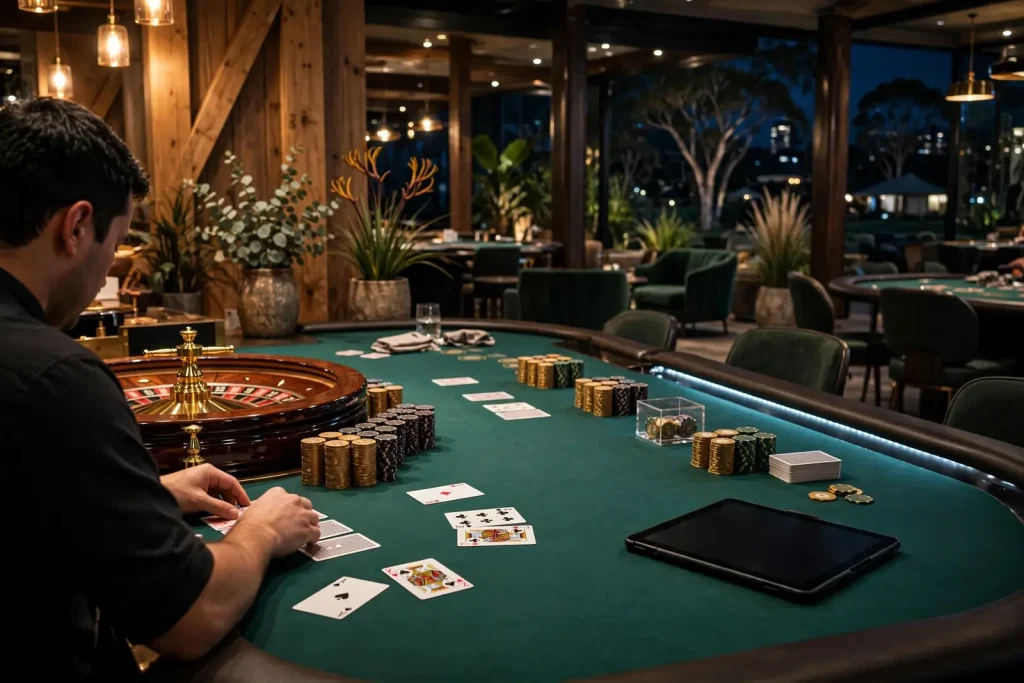
Real Money Casino Table Games in Australia

Plinko Casino Australia: Games, Cashouts and Terms